Inflation vs Deflation: Key Differences, Causes, Effects, and Examples
Inflation and deflation are two important economic concepts that influence purchasing power, business profitability, savings, investments, and the overall growth of a country. Both describe changes in the general price level of goods and services, but they move in opposite directions. Inflation occurs when prices rise over time, while deflation occurs when prices fall over time.
In India, understanding inflation and deflation is important for individuals, business owners, investors, and policymakers. Inflation can increase household expenses and business costs, whereas deflation may reduce revenue, discourage investment, and weaken economic activity. However, the effects of either situation depend on its causes, duration, and the broader economic environment.
What Is Inflation?
Inflation is the sustained increase in the general price level of goods and services over a period of time. When inflation occurs, the purchasing power of money decreases, meaning the same amount of money buys fewer goods and services than before.
For example, suppose a household spends ₹5,000 per month on groceries. If the prices of essential food products increase, the same basket of groceries might cost ₹5,500. The household must spend more money to maintain the same standard of consumption.
Inflation does not mean that every product becomes more expensive at the same rate. Some prices may rise significantly, while others remain stable or decline. Inflation measures the overall change in prices across a selected basket of goods and services.
Types of Inflation
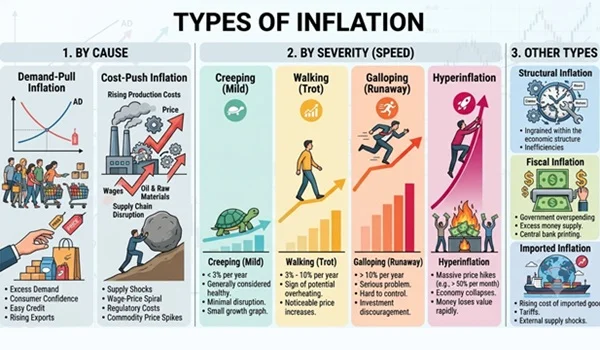
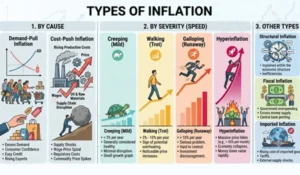
Demand-pull inflation
Demand-pull inflation occurs when demand for goods and services grows faster than the economy’s ability to supply them. Businesses may increase prices when customers are willing to pay more but production cannot expand quickly enough.
For example, strong demand for homes, vehicles, or consumer electronics may push prices higher when supply is limited.
Cost-push inflation
Cost-push inflation occurs when production costs increase. Higher fuel prices, wages, transportation charges, raw material costs, and electricity expenses can make goods and services more expensive.
For example, if transport costs rise, manufacturers and retailers may increase their prices to maintain profit margins.
Built-in inflation
Built-in inflation occurs when workers demand higher wages to compensate for rising living costs and businesses increase prices to cover higher labour expenses. This can create a continuing cycle of wage and price increases.
Imported inflation
Imported inflation occurs when the prices of imported goods or inputs rise. A weaker domestic currency can make imported crude oil, machinery, electronics, and other products more expensive in India.
How Inflation Is Measured in India
Inflation in India is commonly measured using the Consumer Price Index (CPI) and the Wholesale Price Index (WPI).
- Consumer Price Index: Tracks changes in the prices paid by consumers for a basket of goods and services. It is an important measure of retail inflation.
- Wholesale Price Index: Tracks changes in prices at the wholesale level for selected goods.
- Core inflation: Generally refers to an inflation measure that excludes certain volatile components, commonly food and fuel, to help assess underlying price trends.
The Reserve Bank of India considers inflation trends when formulating monetary policy. Its decisions can influence borrowing costs, credit availability, consumption, and investment.
What Is Deflation?
Deflation is a sustained decline in the general price level of goods and services over time. During deflation, the purchasing power of money increases because the same amount of money can buy more goods and services.
For example, if a standard basket of household goods costs ₹10,000 and its price falls to ₹9,500, consumers can purchase the same basket for less money.
However, falling prices are not always beneficial. Deflation can occur because production becomes more efficient, but it can also result from weak consumer demand, falling incomes, excessive debt, or a prolonged economic slowdown.
When consumers expect prices to fall further, they may postpone purchases. Businesses may then experience lower sales, reduce production, delay investment, or cut jobs. These changes can weaken demand further.
Types of Deflation
Demand-driven deflation
This occurs when consumers and businesses reduce spending. Lower demand forces businesses to cut prices to attract customers.
Debt-driven deflation
Debt-driven deflation can occur when falling prices and incomes make existing debt more difficult to repay. Borrowers may sell assets or reduce spending to meet repayments, putting additional downward pressure on demand and prices.
Productivity-driven price declines
Technological improvements and more efficient production can reduce the cost of producing certain goods. For example, advances in manufacturing may make some electronic products cheaper.
Such price declines in individual products are not necessarily the same as economy-wide deflation. Overall deflation means the general price level is falling, not merely that a few products have become less expensive.
Inflation vs Deflation: Key Differences
| Basis of comparison | Inflation | Deflation |
| Meaning | General prices rise over time | General prices fall over time |
| Purchasing power | Decreases | Increases |
| Value of money | Buys fewer goods and services | Buys more goods and services |
| Consumer spending | May increase before further price rises or decline due to reduced affordability | May be postponed if consumers expect lower future prices |
| Business revenue | May rise in nominal terms if selling prices increase | May decline when selling prices and demand fall |
| Production costs | Often rise, depending on the cause | May fall, depending on the cause |
| Debt repayment | Inflation may reduce the real burden of fixed nominal debt | Deflation may increase the real burden of fixed nominal debt |
| Savings | Cash loses purchasing power when inflation is positive | Cash gains purchasing power if prices generally fall |
| Employment | Depends on the causes and policy response | Prolonged deflation can lead to lower production and job losses |
| Economic impact | Moderate inflation may accompany economic growth; high inflation creates instability | Persistent deflation can weaken demand and economic activity |
| Policy response | Central banks may raise interest rates to reduce inflationary pressure | Central banks may reduce interest rates or use other measures to support demand |
Major Causes of Inflation and Deflation
Inflation and deflation can arise from changes in demand, supply, production costs, credit conditions, and public expectations.
Causes of Inflation
- Rapid growth in consumer demand
- Higher fuel and energy prices
- Rising wages and raw material costs
- Supply-chain disruptions
- Currency depreciation that increases import costs
- Excessive credit growth relative to productive capacity
- Crop failures or adverse weather affecting food supplies
- Expectations that prices will continue to rise
For India, food prices, monsoon conditions, international crude oil prices, transportation expenses, and exchange-rate movements can influence inflation.
Causes of Deflation
- A prolonged decline in consumer demand
- Reduced household and business spending
- Falling wages or incomes
- Excess production relative to demand
- Tight credit conditions and reduced lending
- Financial crises or widespread debt repayment pressures
- Expectations of further price declines
Deflation can become particularly difficult to manage when falling prices are accompanied by rising unemployment and declining incomes.
Effects of Inflation on Individuals and Businesses
Inflation affects people differently depending on their income, savings, spending patterns, and debt obligations.
Higher household expenses: Families may need to spend more on groceries, housing, transport, education, healthcare, and utilities.
Reduced purchasing power: If salaries do not rise as quickly as prices, households may be unable to maintain their previous standard of living.
Pressure on businesses: Companies may face higher expenses for rent, salaries, raw materials, fuel, packaging, and logistics.
Changes in investment decisions: Investors may look for assets that have the potential to preserve purchasing power, although no investment is guaranteed to outperform inflation.
Benefits for some borrowers: Inflation can reduce the real value of fixed nominal debt when borrowers’ incomes rise, but this benefit is not guaranteed if interest rates or other expenses increase.
Moderate and predictable inflation can be compatible with economic growth. The main concern is inflation that becomes excessively high, persistent, or unpredictable.
Effects of Deflation on Individuals and Businesses
Deflation may initially appear attractive because prices decline. However, persistent economy-wide deflation can create serious economic challenges.
Lower consumer spending: People may delay buying non-essential products if they expect prices to fall further.
Declining business revenue: Companies may have to reduce prices to generate sales, weakening their ability to cover fixed expenses.
Pressure on employment: Businesses facing lower revenue may reduce working hours, postpone hiring, or lay off employees.
Greater debt burden: Fixed loan repayments become harder to manage if incomes and prices decline.
Reduced investment: Companies may delay expansion because future sales and profits appear uncertain.
Deflation is not always harmful. Lower prices caused by improved productivity can benefit consumers. The concern is a broad, sustained decline in prices associated with weak demand and falling incomes.
Inflation and Deflation Examples in Everyday Life
Consider a family that spends ₹20,000 per month on a fixed basket of household goods and services.
Inflation example
If prices increase by 5%, the same basket costs ₹21,000.
₹21,000
Additional monthly cost: ₹1,000
Deflation example
If prices decrease by 5%, the same basket costs ₹19,000.
₹19,000
Monthly saving: ₹1,000
These are simplified examples. Actual household inflation depends on the products and services a family purchases, and individual prices may change at different rates.
How Inflation and Deflation Affect the Indian Economy
In India, inflation can affect household consumption, business investment, interest rates, government spending, and the cost of imported goods. When retail inflation rises significantly, the Reserve Bank of India may tighten monetary policy by increasing policy interest rates or using other measures to reduce inflationary pressure.
Higher interest rates can make loans more expensive and discourage some borrowing and spending. This may help moderate demand, although monetary policy cannot directly resolve every supply-side problem, such as a temporary shortage of agricultural produce.
During deflationary pressure, a central bank may reduce interest rates or use other monetary tools to encourage borrowing and spending. Government measures may also support demand or address supply constraints.
The appropriate response depends on the cause of the price movement. A temporary fall in vegetable prices does not necessarily mean the economy is experiencing deflation, just as an increase in fuel prices does not automatically mean every part of the economy is facing the same inflation rate.
How Individuals and Businesses Can Prepare
Strategies for managing inflation
- Prepare a household budget and review recurring expenses.
- Compare suppliers and negotiate purchase prices where possible.
- Avoid unnecessary debt with high or variable interest costs.
- Review savings and investments in terms of inflation-adjusted returns.
- Businesses should update pricing carefully and monitor profit margins.
- Maintain adequate working capital to manage higher operating expenses.
Strategies for managing deflation
- Maintain emergency savings and monitor debt repayment capacity.
- Avoid taking on excessive debt based on optimistic income forecasts.
- Businesses should monitor inventory carefully and avoid overstocking.
- Control fixed expenses without damaging essential service quality.
- Evaluate expansion plans using realistic sales and cash-flow assumptions.
- Focus on customer value, operational efficiency, and sustainable pricing.
Neither inflation nor deflation can be managed through a single strategy. Decisions should reflect individual financial circumstances and the actual conditions affecting the business or household.
Frequently Asked Questions
Is inflation better than deflation?
Moderate, stable inflation is generally easier for an economy to manage than prolonged deflation. However, very high inflation can seriously damage purchasing power and economic stability. The effects depend on the level, duration, and causes of the price changes.
Does inflation always reduce economic growth?
No. Moderate inflation can occur alongside rising production, employment, and incomes. High or unpredictable inflation, however, can create uncertainty, reduce purchasing power, and complicate investment decisions.
Is deflation good for consumers?
Falling prices can benefit consumers when they result from better technology or more efficient production. But if deflation reflects weak demand, falling wages, and job losses, the overall impact can be negative.
What is the difference between disinflation and deflation?
Disinflation means the inflation rate is slowing, but prices are still rising. Deflation means the general price level is falling. For example, a reduction in inflation from 6% to 3% is disinflation, not deflation.
How does inflation affect savings?
Inflation reduces the purchasing power of cash when the prices of goods and services rise. To assess the real growth of savings, compare the return earned with inflation and account for taxes and other costs.
Conclusion
Inflation and deflation are opposite movements in the general price level, but both can significantly affect households, businesses, investors, and the wider economy. Inflation reduces the purchasing power of money, while deflation increases it in price terms. However, the economic consequences depend on what causes the change.
For India, monitoring retail prices, production costs, interest rates, household budgets, and business cash flow can help people make better financial decisions. The goal is not simply to have rising or falling prices, but to maintain a stable economic environment that supports sustainable growth, employment, investment, and living standards.