Inflation: Meaning, Causes and Effects
Inflation means a sustained increase in the prices of goods and services over time. When inflation rises, the purchasing power of money generally falls, meaning the same amount of money buys fewer goods and services than before.
For example, if a basket of household items that costs ₹5,000 today costs ₹5,500 next year, the general price level has increased. Inflation is normally measured using a price index. In India, the Consumer Price Index (CPI) is an important measure of consumer inflation, and the Ministry of Statistics and Programme Implementation (MoSPI) calculates CPI based on a basket of goods and services.
Quick Information
| Particular | Details |
| Meaning | General rise in prices over time |
| Main effect | Reduces purchasing power of money |
| Common measure in India | Consumer Price Index (CPI) |
| Major causes | Demand, supply, production costs and monetary conditions |
| Common types | Demand-pull, cost-push and built-in inflation |
| Impact | Affects consumers, businesses, savings and investments |
| Inflation control | Monetary and fiscal measures can be used |
| India’s monetary policy | Focuses primarily on price stability while considering growth |
What Is Inflation?
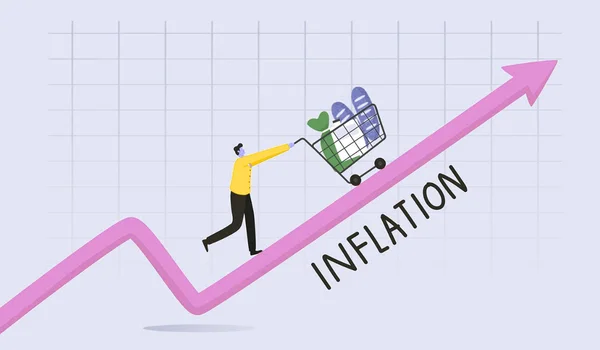
Inflation occurs when the overall price level of goods and services increases over a period of time.
It is important to distinguish inflation from the price increase of a single product.
For example, if only tomatoes become more expensive because of a temporary supply shortage, that does not necessarily mean the economy is experiencing broad-based inflation. Inflation generally refers to a wider increase in prices across the economy.
MoSPI defines inflation as the rate at which prices for a selected basket of goods and services rise over a period, usually measured through the year-on-year change in CPI.
How Is Inflation Measured in India?
The Consumer Price Index (CPI) measures changes in the prices of goods and services consumed by households.
India’s current CPI series uses 2024 as the base year, according to MoSPI. The current CPI basket at the all-India level contains 299 weighted items.
Inflation can be expressed as:
Inflation Rate = [(Current CPI − Previous CPI) / Previous CPI] × 100
For example, if the CPI rises from 150 to 156:
Inflation Rate = [(156 − 150) / 150] × 100
Inflation Rate = 4%
This means the measured price index has increased by 4% compared with the earlier period.
Types of Inflation
- Demand-Pull Inflation
Demand-pull inflation occurs when demand for goods and services grows faster than the economy’s ability to supply them.
For example, if consumer spending increases significantly while production remains limited, businesses may raise prices.
- Cost-Push Inflation
Cost-push inflation occurs when the cost of producing goods and services increases.
Possible causes include:
- Higher fuel prices
- Higher raw-material costs
- Increased wages
- Higher transportation costs
- Supply disruptions
- Increased import costs
Businesses may pass some of these higher costs to consumers through increased prices.
- Built-In Inflation
Built-in inflation can develop when workers seek higher wages because living costs have increased and businesses then increase prices to cover higher labour costs.
This can create a cycle in which wages and prices influence each other.
- Imported Inflation
Imported inflation can occur when the prices of imported goods or inputs increase.
For an economy that imports commodities such as crude oil, changes in global commodity prices and exchange rates can influence domestic prices.
Major Causes of Inflation
Inflation can have multiple causes rather than one single source.
Increase in Demand
When demand grows faster than supply, prices can rise.
Supply Shortages
Poor weather, natural disasters, geopolitical disruptions or other supply problems can reduce the availability of products and push prices higher.
Higher Input Costs
Businesses may face increased costs for fuel, raw materials, labour, transportation or electricity.
Global Commodity Prices
Changes in international prices of commodities such as crude oil can influence domestic production and transportation costs.
Exchange Rate Movements
Changes in the value of the Indian rupee can affect the cost of imported goods and raw materials.
Monetary and Credit Conditions
Interest rates, credit availability and broader monetary conditions can influence spending and demand. RBI explains that monetary policy affects interest rates, money supply and credit availability and can influence aggregate demand, which is an important determinant of inflation.
Effects of Inflation
- Reduces Purchasing Power
The most direct effect of inflation is that money buys fewer goods and services when prices rise.
Suppose ₹1,00,000 is enough to purchase a particular basket of goods today. If that basket becomes significantly more expensive over time, the same ₹1,00,000 will purchase less.
- Increases Household Expenses
Inflation can increase the cost of:
- Food
- Rent
- Transport
- Education
- Healthcare
- Electricity
- Household products
The impact can vary considerably between households because spending patterns are different.
- Affects Savings
If the return on savings is lower than the inflation rate, the purchasing power of those savings can decline over time.
For example, if an investment earns 5% but inflation is 7%, the nominal value may increase while its purchasing power grows more slowly.
- Affects Borrowing Costs
Central banks may use interest-rate policy to influence demand and inflation. Changes in policy rates can eventually affect borrowing and lending rates across the financial system. RBI describes monetary transmission as the process through which policy-rate changes influence market rates, bank lending rates and economic activity.
- Affects Businesses
Businesses may face higher costs for raw materials, wages, transportation and other inputs.
Companies may respond by increasing prices, reducing costs, changing suppliers or accepting lower profit margins.
- Affects Investments
Inflation can affect the real value of investment returns.
For example, a 10% nominal return does not represent a 10% increase in purchasing power if prices have also risen substantially.
This is why investors often consider real return, which accounts for inflation.
Inflation and Purchasing Power
Purchasing power refers to how much goods and services a particular amount of money can buy.
If inflation is 5% per year, prices are increasing on average, although individual products may rise by more or less than 5%.
Over several years, even moderate inflation can make a significant difference.
For example, if prices increase by 5% every year, a product costing ₹10,000 today would cost approximately ₹16,289 after 10 years if that 5% rate were maintained continuously.
This demonstrates why inflation is important when planning long-term savings and retirement.
Inflation in India and the RBI
The Reserve Bank of India’s monetary policy framework gives primary importance to price stability while keeping economic growth in mind. The framework uses CPI inflation as its numerical inflation target.
The inflation-targeting framework has historically used a 4% CPI inflation target with a tolerance band of 2% to 6%. The applicable target period and government notifications should be checked for the relevant period because the framework is reviewed periodically.
The RBI can influence economic conditions through monetary-policy tools such as the repo rate and liquidity measures. These tools affect borrowing costs, credit conditions and demand, although monetary policy operates with a time lag.
How Can Inflation Be Controlled?
Controlling inflation can involve several measures.
Monetary Policy
The central bank can adjust policy rates and use other monetary tools to influence demand and financial conditions.
Improving Supply
Increasing production and improving supply chains can reduce shortages and supply-side price pressures.
Government Measures
Depending on circumstances, governments can use measures related to taxation, imports, subsidies, public spending, food supply and other economic policies.
Better Infrastructure
Efficient transportation, storage and distribution can reduce supply bottlenecks and wastage.
No single measure can address every type of inflation because the underlying causes can differ.
Inflation vs Deflation
| Factor | Inflation | Deflation |
| General price level | Rises | Falls |
| Purchasing power of money | Generally decreases | Generally increases |
| Consumer prices | Generally increase | Generally decrease |
| Economic concern | High or persistent inflation can reduce purchasing power | Persistent deflation can weaken demand and economic activity |
A moderate and stable inflation environment is different from very high or persistent inflation.
How Does Inflation Affect Personal Finance?
Individuals can consider inflation when making long-term financial plans.
Useful steps include:
- Maintaining an emergency fund
- Reviewing savings returns
- Considering inflation while setting financial goals
- Diversifying investments according to risk tolerance
- Increasing savings as income grows
- Planning retirement expenses using future, rather than current, costs
The objective is not simply to earn a nominal return but to understand whether the money is maintaining or increasing its purchasing power after considering inflation.
FAQs
What is inflation in simple words?
Inflation is a general increase in the prices of goods and services over time, which generally reduces the purchasing power of money.
What is the main measure of inflation in India?
Consumer Price Index (CPI) inflation is the main measure used for India’s inflation-targeting monetary policy framework. MoSPI publishes CPI data for rural, urban and combined sectors.
What are the main causes of inflation?
Common causes include increased demand, supply shortages, higher production costs, commodity-price changes, exchange-rate movements and monetary conditions.
How does inflation affect savings?
If inflation is higher than the return earned on savings, the purchasing power of those savings can decline over time.
Is inflation always bad?
Inflation has different economic effects depending on its level, persistence and causes. The focus of monetary policy is generally on maintaining price stability rather than eliminating every price change.
How does inflation affect loans?
Inflation can influence interest rates and borrowing costs through monetary policy. The actual impact on a particular loan depends on its interest-rate structure and other terms.
Conclusion
Inflation refers to a general increase in the prices of goods and services over time. It affects purchasing power, household expenses, savings, investments, businesses and borrowing costs.
Understanding inflation is important for personal financial planning because the value of money changes over time. When saving or investing for long-term goals, considering inflation alongside expected returns can provide a more realistic picture of future purchasing power.